Digital Purgatory: 99% of Companies Are Trapped Between Paper and AI
Billy Holder, CEO & Founder, Project Aidra

“We’ve digitized our storage and transmission, but we haven’t transformed our capture and processing.”
After 28 years in the built environment—from construction sites to corporate boardrooms—I’ve witnessed the same painful cycle repeat across thousands of organizations: the promise of digital transformation followed by the reality of digital purgatory.
McKinsey’s “State of AI 2025” report confirms what many of us suspected: while 88% of organizations now use AI in at least one business function, only 1% of company executives describe their AI rollouts as “mature.” The other 99% aren’t just failing to achieve AI success—they’re trapped in a liminal space between their paper-based past and their digital future, spending more resources than ever while achieving less efficiency.
This isn’t a technology problem. It’s a transformation problem.
The Transcription Trap That the 99%
Let me paint you a picture that will sound familiar. Sarah, a quality inspector at a manufacturing plant, walks through her facility with a tablet, documenting equipment conditions. She takes photos, makes voice notes, fills out digital forms. At first glance, this looks like successful digital transformation.
But here’s what actually happens: Sarah spends 3 hours inspecting. Then she spends another 2 hours back at her desk transcribing her voice notes, organizing photos, entering data into multiple systems, creating reports, and following up on tasks. The inspection took 3 hours. The documentation and data entry took 2 hours.
Sarah isn’t a digital worker. She’s a data entry technician who happens to work in manufacturing.
This is the transcription trap—and according to Parseur’s 2024 survey, manual data entry alone costs U.S. companies an average of $28,500 per employee per year, with over 50% of professionals admitting these processes lead to costly errors, delays, and lost opportunities.
The Four Pillars of Digital Purgatory
After talking to hundreds that have had failed digital initiatives across multiple industries, I’ve identified four fundamental reasons why companies get trapped:
- The Legacy System Web
Most organizations don’t have integrated systems—they have digital spaghetti. Their CMMS talks to their BMS, which sort of integrates with their ERP, which has an API connection to their GIS system. Data flows between systems like a game of telephone, with each translation introducing new opportunities for error and inefficiency.
The result? Employees spend more time managing systems than the systems spend managing work.
- The Incremental Change Fallacy
Companies make the mistake of digitizing their existing chaos rather than transforming their processes. They replace paper forms with digital forms, paper checklists with tablet checklists, handwritten notes with typed notes.
They’ve digitized the storage and transmission of information, but the fundamental workflow—observe, document, transcribe, input, verify—remains unchanged from 3,400 years ago.
- Cultural Resistance Meets Poor Change Management
Digital transformation fails when organizations treat it as a technology rollout rather than a cultural evolution. Employees see new systems as additional work rather than work replacement. Without proper change management, resistance builds, workarounds proliferate, and initiatives collapse under their own complexity.
The most dangerous phrase in business transformation isn’t “this won’t work”—it’s “we’ve always done it this way.”
- The Readiness Illusion
Perhaps the most critical factor: companies dramatically overestimate their readiness for advanced technology. They see AI success stories and assume they can jump directly from manual processes to artificial intelligence, skipping the foundational work of process optimization and data quality improvement.
This is like trying to build a skyscraper on quicksand. Without solid operational foundations, even the most sophisticated AI will amplify existing inefficiencies rather than resolve them.
The 1% That Escaped: What They Did Differently

The companies that successfully escaped digital purgatory didn’t just implement better technology—they transformed their fundamental approach to work. Here’s how:
1. They Solved the Process First, Technology Second
Instead of asking “What technology should we buy?” they asked “What work should humans stop doing?” They identified their highest-value activities and ruthlessly eliminated everything that didn’t directly contribute to those outcomes.
2. They Integrated Capture, Not Just Storage
While the 99% focused on better ways to store and share information, the 1% focused on fundamentally changing how information gets captured. They understood that the bottleneck isn’t storage or transmission—it’s the human time required to translate reality into data.
3. They Treated Change as Strategy, Not Implementation
Successful companies approached digital transformation as organizational change management first, technology implementation second. They invested heavily in culture, communication, and continuous learning rather than just training and deployment.
4. They Measured Impact, Not Activity
While trapped companies measured system adoption rates and user satisfaction scores, successful companies measured operational outcomes: time saved, decisions accelerated, risks mitigated, and strategic capacity reclaimed.
The Cost of Staying Trapped
The financial impact of digital purgatory extends far beyond technology investments. Companies trapped in this space face:
- Labor Tax: Employees spending 25-40% of their time on data transcription rather than strategic work
- Decision Delays: Critical information locked in manual processes, slowing response times
- Compliance Risk: Manual documentation creating gaps in regulatory compliance
- Competitive Disadvantage: Resources consumed by inefficient processes rather than innovation
- Employee Frustration: High-skill workers performing low-value tasks, leading to turnover and disengagement
According to Siemens’ “The True Cost of Downtime 2024” report, unplanned downtime costs Fortune Global 500 industrial companies almost $1.5 trillion annually—equivalent to 11% of their annual revenues. While this specific research focuses on manufacturing downtime, the underlying causes—manual processes, poor data quality, and inefficient information capture—affect organizations across all industries.
The Path Forward: Practical AI, Not Pilot Purgatory
Escaping digital purgatory requires a different approach—one I call “Practical AI.” This isn’t about implementing the latest AI trend or running endless pilots. It’s about using artificial intelligence to solve specific, high-impact problems with measurable outcomes.
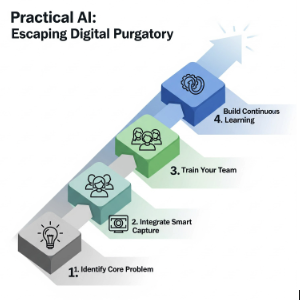
The four-step framework that works:
- Identify the Core Problem: Focus on your highest-cost, lowest-value activities
Whats the real problem in your organizations workflows? Is it manual documentation, information retrieval, data accuracy? Or something else? Find this one thing and solve one problem at a time. Many organizaitons try to solve everything at once- That is a recipe for failure.
- Integrate Smart Capture: Transform how information enters your systems
If data accuracy, timeliness, or retrieval are your pain points, using an ai solution that can identify, categorize, and recall data verom a visual input source is an easy way to get high reuters on an AI deployment.
- Train Your Team: Develop AI literacy alongside operational competency
A lot of teams fail at AI and software deployments because the team isnt given enough instruction on how to use it. . Then when something goes wrong they blame the technology. Train your teams and give them the knowledge to use the system and it will be much more impactful.
- Build Continuous Learning: Create feedback loops that improve both human and artificial intelligence
We know this is true with our human employees. A 360 feedback loop is instrumental in high preforming teams. Feedback isnt personal, its for the betterment of the team. SOftware and AI is the same- if there is something wrong the only way to make it right is to tell the software it was wrong. There by giving it feedback to improve.
Companies following this approach report remarkable results: 85% reduction in documentation time, 20-40% increase in asset life, and most importantly, the reclamation of strategic time for their most valuable employees.
The Legacy Decision
Every organization today faces what I call “The Legacy Decision”: Will you be remembered as a company that transformed work for the better, or one that spent decades trapped between your digital aspirations and analog reality?
The 99% trapped in digital purgatory share a common characteristic: they’re focused on managing their technology rather than transforming their work. The 1% that escaped focused on transforming work and let technology follow.
The question isn’t whether your industry needs digital transformation. The question is whether you’ll join the 1% that successfully achieves it or remain trapped with the 99% that mistakes activity for progress.
The choice is yours. But choose quickly—while you’re managing your digital purgatory, your competition might be transforming their operations.
## Sources and References:
- **McKinsey & Company**: “The State of AI 2025: Global Survey” – McKinsey Global Institute, 2025
- **Siemens Digital Industries**: “The True Cost of Downtime 2024” – Senseye Predictive Maintenance Report, published April 2023, available at siemens.com/blog
- **Parseur**: “Manual Data Entry Survey 2024” – Survey of U.S. business professionals on manual data entry costs and productivity impact, 2024
- **Additional Data Sources**: Various industry reports on digital transformation failure rates, manual process costs, and AI adoption challenges across enterprise organizations.
© 2026 Project Aidra.
Schedule a demo
Schedule a demo today & learn how Project Aidra is reducing the load of manual documentation!
Learn More
Learn More about our solutions, and how they can help you save time, redeploy human capital, and improve your inspection intelligence today.