One year later….

What Happened After We Bet Everything on Project Aidra
We’d like to say it was the plan all along — clean runway, careful sequencing, a pitch deck with the right logo already slotted in. It wasn’t. It was a leap, and then it was National Building Contractors saying yes 29 days later. One year later, that’s still the fastest close we’ve had, and it set the tone for everything that came after: building something real, put it in front of people who manage buildings, and let the work speak for itself.
The idea behind Project Aidra didn’t start as a platform. It started as a much smaller problem: figuring out who put the hole in the drywall. Identifying dorm room damage — fast, accurately, without a facilities team walking every hallway and writing it all down on a clipboard.
That narrow problem turned out to be a preview of a much bigger one. Facility teams everywhere are sitting on the same issue — too much square footage, not enough time, and no fast way to turn a walkthrough into a decision. A year of client work stretched that original idea into a multimodal platform covering facility condition assessments, asset data capture, and thermal image reporting. The dorm room problem is still in there, technically. It’s just not the whole story anymore.
Talk is cheap in facilities technologies; everyone claims their AI saves time. What we can point to is a year of people willing to test that claim with their own buildings.
Early Success and Recognition
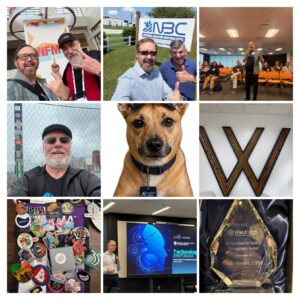
National Building Contractors took the first chance on us in August, a month after we existed as a full-time company. Westminster Schools brought us into a K-12 environment in December, where “condition assessment” means something different than it does in a college dormitory or an airport hangar. Left Coast Facility Consultants came aboard in February, almost exactly a year after our beta wrapped — proof that the platform had matured enough to hold up outside our own hands. Grant Aviation followed in April, and in June we signed Servus Ltd, our first client outside the U.S. Farnsworth Group joined most recently, in July.
Along the way, two organizations pushed us well beyond a standard engagement wouldn’t have: CGL Companies ran a 6 month project with us in October covering 1.2 million square feet across five college campuses, still our largest single footprint. Tetra Tech ran a project based engagement from September through December. Both taught us things about how the platform performs on a scale that we couldn’t have learned any other way, and we’re grateful they were willing to find out with us.
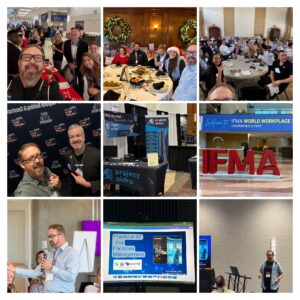
If you were at a Facilities Management conference this year, there’s a decent chance you ran into us. We took our first booth to NFMT Remix in Orlando in October. From there it didn’t really stop: a room of 300 middle schoolers at the Gwinnett County Science, Engineering & Innovation Fair in January, back-to-back events in South Carolina and Charlotte in March (SCAPPA and NFMT East, a last-minute road trip decision that turned out to be the right one), Facility Fusion in San Francisco in April, and a stretch in June — CoreNet/IFMA’s Tech Symposium, the IFMA Silicon Valley Mosh Pit, and a trip to meet the Trinidad and Tobago Chamber of Commerce — that hit three events in ten days. Exhausted but encouraged in May, we were able to be home in Atlanta.
In December, our local IFMA chapter gave us its Achievement in Facilities award. It’s the kind of recognition that means the most, because it came from people who know exactly how hard the problem is.
What we learned in our first year:
Building a company is a different job than working inside one, and no amount of planning replaces just doing it for twelve months. We got better at product development, at sales, at knowing which conversations to have and which to let go. But the biggest lesson wasn’t operational, it’s that technology alone doesn’t create value. The platform only matters because it’s built around how facility teams work, not around what would be technically impressive to demo.
That’s the same idea behind how we think about the “AI” part of what we do: human-AI partnership, not replacement. The teams we work with aren’t looking to hand the keys to an algorithm. They’re looking for hours back and better information, decisions made by the people who know their buildings, just faster and with less guesswork.
A year ago, going all in meant a decision with no guarantees attached to it. What we have now is: a client list that spans facilities, education, and aviation; our first international relationship; a growing reputation on the conference circuit; and a platform that is considerably more capable than the one we started with.
If your team is still doing condition assessments with a clipboard and a spreadsheet, or you’re curious what asset data capture or thermal reporting looks like when it doesn’t take days, we’d love to show you. aidra@projectaidra.net
Unlock Your Facility's Potential
Calculate your time savings using our ROI calculator
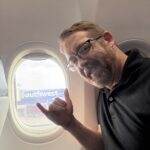
Written by Billy Holder, Founder CEO
Billy Holder is the CEO and Founder of Project Aidra, and a Certified Facility Manager in IFMA. With a 28-year career that began in construction and progressed through hands-on university facilities management at Georgia State and Georgia Tech, Billy brings a rare "slab-to-C-suite" perspective to the challenges facing the built environment. He is passionate about leveraging technology to augment the expertise of facility professionals, empowering them to drive strategic value.