aidra@projectaidra.net
Project Aidra logo
  • Home
  • Solutions
    • Condition Assessments
    • Thermal Image Analysis
    • Asset Management Analysis
    • Education Sector
  • Pricing
  • About
  • Stay in the know!
  • ROI Calculator
  • Blogs
  • FAQ
    • Trust Center
    • System Status
Log In
  • Edit article
  • View stats
  • View post

AI Doesn’t Replace Experts. It Supercharges Them.

How Smart Technology Amplifies Human Expertise in Property Management

The conversation around artificial intelligence often triggers a familiar concern: “Will AI replace me?” In the property and facility management industry, where expertise is built over decades of hands-on experience, this anxiety is particularly understandable. But here’s the reality that research consistently supports: AI doesn’t replace experts—it supercharges them.

The Augmentation Advantage: What the Data Shows

A comprehensive study by MIT’s Computer Science and Artificial Intelligence Laboratory found that human-AI collaboration improved performance by 85% compared to humans or AI working alone. In knowledge work specifically, McKinsey Global Institute research indicates that AI augmentation can increase productivity by 20-25% while simultaneously improving job satisfaction. The key insight? AI excels at processing vast amounts of data quickly and consistently, while humans excel at interpretation, strategic thinking, and complex problem-solving. When combined, they create a powerhouse team.

The Current Challenge in Property Management

Consider the typical facility condition assessment. An experienced property manager might spend 6-8 hours conducting a thorough inspection, then another 4-6 hours compiling reports, organizing photos, and formatting findings. That’s 10-14 hours of valuable expertise tied up in data collection and administrative tasks. According to the International Facility Management Association (IFMA), facility managers spend approximately 40% of their time on routine documentation and reporting tasks—time that could be redirected toward strategic planning, relationship building, and proactive maintenance strategies.

Article content
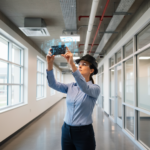
A maintenance technician documents wall damage with a smartphone.

How AI Augmentation Works in Practice

At Project Aidra, we’ve designed our platform around this augmentation principle. Here’s how it transforms the workflow:

Traditional Process:

  • 8 hours on-site inspection
  • 6 hours report compilation
  • Potential for inconsistent documentation
  • Limited time for analysis and strategic planning

AI-Augmented Process:

  • 2 hours capturing comprehensive video/photos
  • 30 minutes reviewing AI-generated reports
  • Consistent, detailed documentation every time
  • 11+ hours freed for high-value strategic work

The Multiplication Effect

Research from Harvard Business School shows that when AI handles routine cognitive tasks, professionals can redirect their energy toward activities that leverage uniquely human skills:

Strategic Planning: With consistent baseline data from AI analysis, facility managers can identify patterns and trends that inform long-term capital planning and preventive maintenance strategies.

Relationship Building: More time to engage with stakeholders, understand evolving needs, and build the partnerships that drive organizational success.

Innovation: Space to explore new solutions, technologies, and approaches that can further optimize facility operations.

Mentorship: Opportunity to develop junior team members and share institutional knowledge—something no AI can replicate.

Article content
An image of a facility manager using the Project Aidra browser interface.

The Human Element Remains Critical

While AI can identify a crack in a foundation or detect moisture patterns that suggest potential issues, it takes human expertise to understand the broader context: How does this relate to the building’s history? What are the cost-benefit implications of different repair approaches? How might this impact the overall facility strategy? The most experienced professionals in our industry possess something irreplaceable: contextual intelligence built through years of problem-solving, relationship-building, and strategic thinking. AI doesn’t diminish this value—it amplifies it by removing the administrative burden that often prevents experts from applying their highest-level skills.

Looking Forward

As AI technology continues to evolve, the most successful facility and property management professionals will be those who embrace augmentation rather than resist it. They’ll use AI to handle the routine, repetitive tasks that don’t require human judgment, freeing themselves to focus on the complex, strategic, and interpersonal aspects of their work that create real value. The question isn’t whether AI will change our industry—it’s whether we’ll harness its power to become more effective, strategic, and satisfied in our roles.

Your Move

If you’re a facility or property management professional, consider this: What would you do with an extra 10-15 hours per week? What strategic initiatives have been sitting on your back burner because you’re buried in routine inspections and reporting? AI augmentation isn’t about replacing your expertise—it’s about unleashing it.


Ready to see how AI can supercharge your facility management workflow? Learn more about Project Aidra’s AI-powered condition assessment platform at projectaidra.net


Schedule a demo

Schedule a demo today & learn how Project Aidra is reducing the load of manual documentation!

Schedule Your Demo

Learn More

Learn More about our solutions, and how they can help you save time, redeploy human capital, and improve your inspection intelligence today.
Explore the Solutions

Supercharge Your Team

by billy_aidra | Feb 1, 2026 | Cost of time, Future of Facilities | 0 comments

What Happened After We Bet Everything on Project Aidra

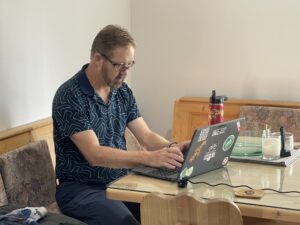
Founder working on a laptop

We’d like to say it was the plan all along — clean runway, careful sequencing, a pitch deck with the right logo already slotted in. It wasn’t. It was a leap, and then it was National Building Contractors saying yes 29 days later. One year later, that’s still the fastest close we’ve had, and it set the tone for everything that came after: building something real, put it in front of people who manage buildings, and let the work speak for itself.

The idea behind Project Aidra didn’t start as a platform. It started as a much smaller problem: figuring out who put the hole in the drywall. Identifying dorm room damage — fast, accurately, without a facilities team walking every hallway and writing it all down on a clipboard.

That narrow problem turned out to be a preview of a much bigger one. Facility teams everywhere are sitting on the same issue — too much square footage, not enough time, and no fast way to turn a walkthrough into a decision. A year of client work stretched that original idea into a multimodal platform covering facility condition assessments, asset data capture, and thermal image reporting. The dorm room problem is still in there, technically. It’s just not the whole story anymore.

Talk is cheap in facilities technologies; everyone claims their AI saves time. What we can point to is a year of people willing to test that claim with their own buildings.

College of clients and growth<br />

Early Success and Recognition

National Building Contractors took the first chance on us in August, a month after we existed as a full-time company. Westminster Schools brought us into a K-12 environment in December, where “condition assessment” means something different than it does in a college dormitory or an airport hangar. Left Coast Facility Consultants came aboard in February, almost exactly a year after our beta wrapped — proof that the platform had matured enough to hold up outside our own hands. Grant Aviation followed in April, and in June we signed Servus Ltd, our first client outside the U.S. Farnsworth Group joined most recently, in July.

Along the way, two organizations pushed us well beyond a standard engagement wouldn’t have: CGL Companies ran a 6 month project with us in October covering 1.2 million square feet across five college campuses, still our largest single footprint. Tetra Tech ran a project based engagement from September through December. Both taught us things about how the platform performs on a scale that we couldn’t have learned any other way, and we’re grateful they were willing to find out with us.

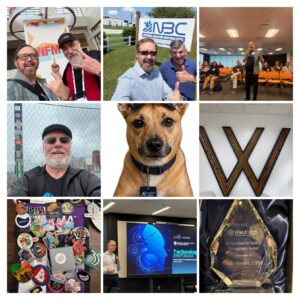
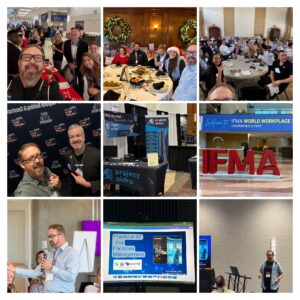
If you were at a Facilities Management conference this year, there’s a decent chance you ran into us. We took our first booth to NFMT Remix in Orlando in October. From there it didn’t really stop: a room of 300 middle schoolers at the Gwinnett County Science, Engineering & Innovation Fair in January, back-to-back events in South Carolina and Charlotte in March (SCAPPA and NFMT East, a last-minute road trip decision that turned out to be the right one), Facility Fusion in San Francisco in April, and a stretch in June — CoreNet/IFMA’s Tech Symposium, the IFMA Silicon Valley Mosh Pit, and a trip to meet the Trinidad and Tobago Chamber of Commerce — that hit three events in ten days. Exhausted but encouraged in May, we were able to be home in Atlanta.

In December, our local IFMA chapter gave us its Achievement in Facilities award. It’s the kind of recognition that means the most, because it came from people who know exactly how hard the problem is.

Community support and appearances<br />

What we learned in our first year:

Building a company is a different job than working inside one, and no amount of planning replaces just doing it for twelve months. We got better at product development, at sales, at knowing which conversations to have and which to let go. But the biggest lesson wasn’t operational, it’s that technology alone doesn’t create value. The platform only matters because it’s built around how facility teams work, not around what would be technically impressive to demo.

That’s the same idea behind how we think about the “AI” part of what we do: human-AI partnership, not replacement. The teams we work with aren’t looking to hand the keys to an algorithm. They’re looking for hours back and better information, decisions made by the people who know their buildings, just faster and with less guesswork.

A year ago, going all in meant a decision with no guarantees attached to it. What we have now is: a client list that spans facilities, education, and aviation; our first international relationship; a growing reputation on the conference circuit; and a platform that is considerably more capable than the one we started with.

If your team is still doing condition assessments with a clipboard and a spreadsheet, or you’re curious what asset data capture or thermal reporting looks like when it doesn’t take days, we’d love to show you. aidra@projectaidra.net


Unlock Your Facility's Potential

Calculate your time savings using our ROI calculator

Calculate your ROI

Written by Billy Holder, Founder CEO

Billy Holder is the CEO and Founder of Project Aidra, and a Certified Facility Manager in IFMA. With a 28-year career that began in construction and progressed through hands-on university facilities management at Georgia State and Georgia Tech, Billy brings a rare "slab-to-C-suite" perspective to the challenges facing the built environment. He is passionate about leveraging technology to augment the expertise of facility professionals, empowering them to drive strategic value.